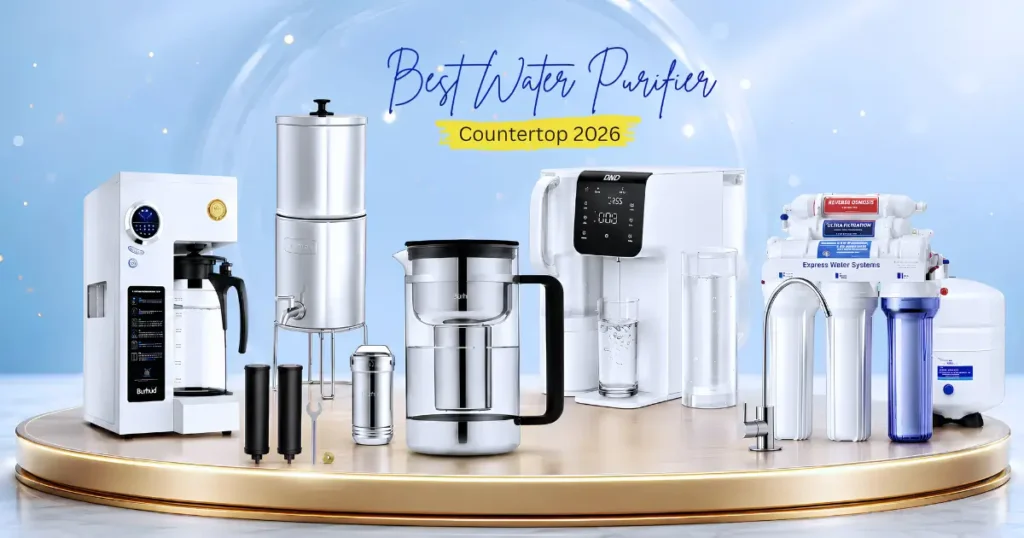
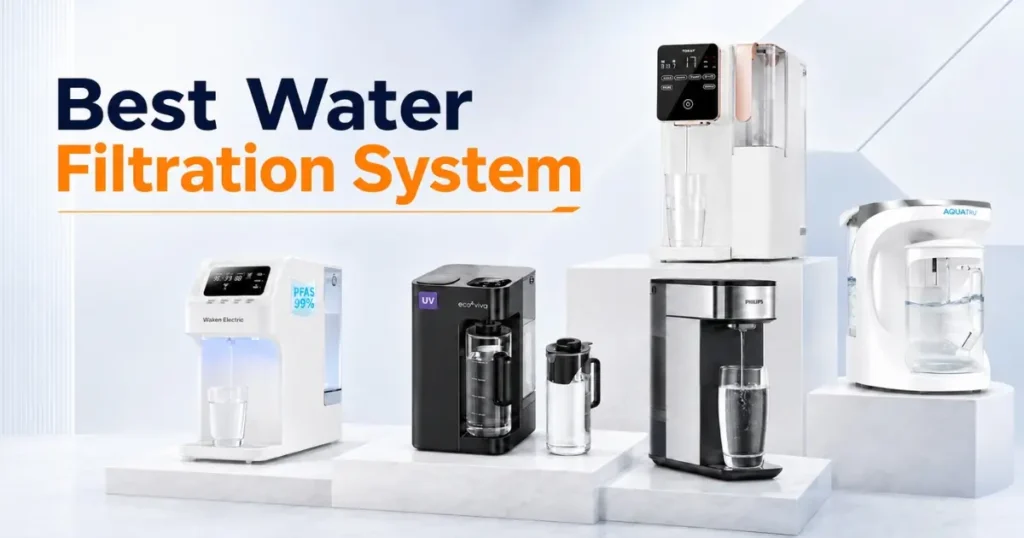
Choosing the best water filtration system in 2026 means weighing more than price. This guide compares five popular countertop water filtration systems — the AquaTru Glass Carafe, Waken Electric C11S, Ecoviva Mate 3 UV, TOKIT T1, and Philips RO — on the things that actually matter: TDS reduction, PFAS (“forever chemical”) removal, NSF certification, and no-install countertop convenience.
Water Filtration System Comparison Table
| Model | Filtration | Certifications | Drain Ratio / Flow | Special Features | Best For |
| AquaTru Glass Carafe | 4-stage RO (Pre/Carbon, RO, VOC Carbon) | NSF-tested (IAPMO) | Not specified | Removes 84 contaminants incl. PFOA/PFOS, microplastics | Broadest contaminant removal |
| Waken Electric C11S | 8-stage RO + UV | NSF/ANSI 58 & 61 | 4:1 pure-to-drain, 530 GPD | TDS monitor, PFAS free, 14-sec fill | Water-saving efficiency |
| Ecoviva Mate 3 UV | 9-stage RO + UV + mineral | Third-party tested | 3:1 pure-to-drain | Dual auto-fill pitchers, self-cleaning | Families & multi-person households |
| TOKIT T1 | RO + alkaline remineralization | NSF/ANSI 58 & 42, SGS | Not specified | Child lock, LED display, 24–36 mo. filter life | Long-lasting value |
| PHILIPS RO | 5-stage RO + Aquaporin Inside | NSF/ANSI/CAN 372 & 58 | ~9 oz/min flow | Filters to 0.0001 microns, compact footprint | Compact & portable |
AquaTru Glass Carafe – Best Overall Water Filtration System
What Makes It Worth Considering
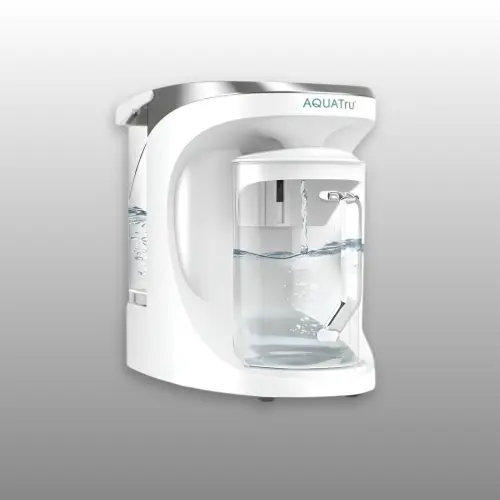
AquaTru didn’t design the Glass Carafe to win on one flashy spec — the company built it for breadth instead. A basic pitcher filter mostly just knocks out chlorine and bad taste, but this one goes a lot further. Independent testing shows it reduces 84 contaminants, including PFOA, PFOS, chromium-6, arsenic, fluoride, and microplastics — exactly the categories most household filters never touch. As an aquatru countertop water filter, it runs a 4-stage reverse osmosis process and finishes in a removable borosilicate glass aquatru carafe instead of a plastic tank, which is a nice touch if you’d rather not store drinking water in plastic.
Key Features
- Filtration: 4-stage reverse osmosis — Pre/Carbon Filter, RO Filter, VOC Carbon Filter
- IAPMO certifies it to NSF standards for water purity
- Requires no plumbing, drilling, or installation — plugs into any standard outlet
- Pre/Carbon Filter rated for 6 months or 300 gallons; RO Filter for 1 year or 600 gallons; VOC Carbon Filter for 1 year or 300 gallons
- Includes a 1-year warranty plus a 30-day money-back guarantee
Specifications
| Spec | Detail |
| Brand | AQUA TRU |
| Installation Type | Countertop |
| Material | Borosilicate Glass |
| Product Dimensions | 14″L x 7.5″W x 13″H |
| Purification Method | Reverse Osmosis |
| Power Source | Corded Electric |
Pros: Removes a wider range of contaminants than most countertop competitors, including PFAS and microplastics; the glass carafe avoids storing water in plastic; a full 1-year warranty and 30-day guarantee back the purchase. Cons: The brand doesn’t publish a drain ratio, so it’s hard to compare water-waste efficiency directly; three separate filter stages mean more parts to keep track of than a single-cartridge system.
Why This One Ranks Where It Does
Nothing else in this lineup publishes a contaminant list this long, and IAPMO’s third-party testing backs it up rather than just AquaTru’s own marketing. If you think of a household water filter as a health decision first and a convenience feature second, that’s really the whole case for putting the AquaTru Glass Carafe at the top.
AquaTru Glass Carafe FAQ
Does the AquaTru Glass Carafe remove PFAS? Yes — independent testing confirms it reduces PFOA and PFOS along with 84 total contaminants, including microplastics, chromium-6, and arsenic.
Do I need to install the AquaTru countertop water filter? No. Like every other countertop water filtration system on this list, it plugs into a standard outlet and skips the plumbing or drilling entirely.
How often do the AquaTru carafe’s filters need replacing? The Pre/Carbon Filter lasts about 6 months or 300 gallons, the RO Filter about a year or 600 gallons, and the VOC Carbon Filter about a year or 300 gallons.
Waken Electric C11S – Best Water-Saving Countertop RO System
What Makes It Worth Considering
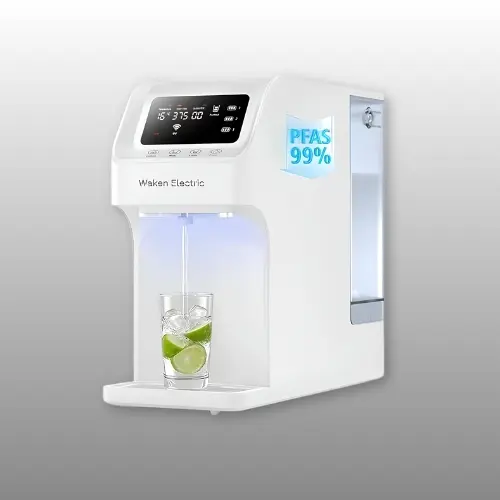
Older RO systems can waste several gallons of water for every gallon they actually purify, which is a real problem if you’re running one daily. To close that gap, Waken Electric built the C11S around a 4:1 pure-to-drain ratio, paired with an 8-stage process that layers UV light and premium coconut-shell activated carbon on top of standard RO filtration. Over a year of everyday use, that drain-ratio difference genuinely adds up.
Key Features
- Filtration: 8-stage RO with UV support and Sri Lankan coconut shell activated carbon
- Carries NSF/ANSI 58 & 61 certification; SGS testing confirms PFAS-free construction
- Includes a built-in TDS monitor with real-time readings and filter-life tracking
- Delivers a 4:1 pure-to-drain ratio with a 530 GPD flow rate — a fresh cup in about 14 seconds
- Requires no installation — plug-and-play countertop design
Specifications
| Spec | Detail |
| Brand | Waken Electric |
| Installation Type | Countertop |
| Material | BPA-Free Food Graded Plastic |
| Product Dimensions | 18.3″L x 7.28″W x 15.04″H |
| Purification Method | Reverse Osmosis |
| Item Weight | 8.9 pounds |
Pros: The 4:1 drain ratio wastes noticeably less water than typical countertop RO units; a built-in TDS display makes water quality visible without guesswork; the fill time runs about 14 seconds; dual NSF/ANSI certification (58 & 61) backs the claims. Cons: At 18.3″ long, it eats up more counter depth than some of the more compact alternatives here; since there’s no companion app, monitoring stays limited to the on-unit display.
Why This One Ranks Where It Does
Out of everything in this comparison, the Waken Electric C11S posts the most water-efficient drain ratio and still carries NSF/ANSI 58 & 61 certification — that combination is genuinely hard to find at this price and size. Pair that with real-time TDS monitoring, and it’s easy to see why this is the pick for anyone trying to cut down on wasted water.
Waken Electric C11S FAQ
Is the Waken Electric C11S a good water filtration system for reducing water waste? Yes — its 4:1 pure-to-drain ratio beats the traditional RO ratios most countertop systems ship with.
Does the Waken Electric C11S need installation? No, since it’s a plug-and-play countertop unit, it needs no plumbing or drilling.
What does the Waken Electric C11S’s TDS monitor show? It displays real-time TDS readings plus filter-life tracking for each of the three pre-installed filters.
Ecoviva Mate 3 UV – Best Countertop Pick for Families
What Makes It Worth Considering
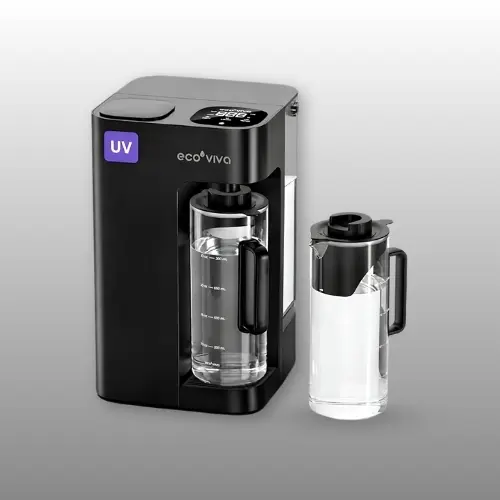
Anyone who’s used a countertop filter pitcher knows the annoyance of running dry mid-afternoon and having to wait it out. To solve that, Ecoviva added two auto-fill pitchers — one stays in use while the other refills on its own, and you can always keep a spare chilling in the fridge. Behind that convenience sits a 9-stage RO and UV process, which is why Ecoviva built this one specifically for households where the tap gets used constantly throughout the day.
Key Features
- Filtration: 9-stage RO with UV and mineral enhancement; PCR and PPC dual technology
- Includes dual auto-fill borosilicate glass pitchers for alternating, no-wait use
- Runs a 3:1 pure-to-drain ratio and performs a self-cleaning cycle every 12 hours
- Displays real-time TDS and filter-life monitoring on a smart screen
- Comes backed by a 5-year warranty
Specifications
| Spec | Detail |
| Brand | Ecoviva |
| Installation Type | Countertop |
| Material | Borosilicate Glass Pitcher |
| Product Dimensions | 9.06″L x 9.06″W x 14.69″H |
| Purification Method | Reverse Osmosis |
| Power Source | Corded Electric |
Pros: The dual-pitcher design removes the usual wait for a refill; a long 5-year warranty goes well beyond what most competitors offer; a self-cleaning cycle reduces manual maintenance; the footprint stays compact despite the 9-stage process. Cons: Ecoviva built the filter-replacement schedule around an annual cycle, so budgeting is less flexible than systems with shorter, swappable stages; glass pitchers need more careful handling than plastic ones.
Why This One Ranks Where It Does
The dual auto-fill pitcher setup is genuinely unique here, and it directly fixes the single biggest annoyance with countertop units — waiting around for a refill. For a busy, multi-person household, that convenience, combined with a warranty that outlasts every other model on this list, is what earns it the family pick.
Ecoviva Mate 3 UV FAQ
How do the two pitchers on the Ecoviva Mate 3 UV work? One stays in use while the other refills automatically, so you rotate between them without ever waiting on the machine.
Does the Ecoviva Mate 3 UV self-clean? Yes — it runs a self-cleaning cycle every 12 hours to help keep buildup from forming inside the unit.
What warranty comes with the Ecoviva Mate 3 UV? A 5-year warranty, longer than any other countertop water filtration system in this comparison.
TOKIT T1 – Best Value Countertop RO Filter
What Makes It Worth Considering
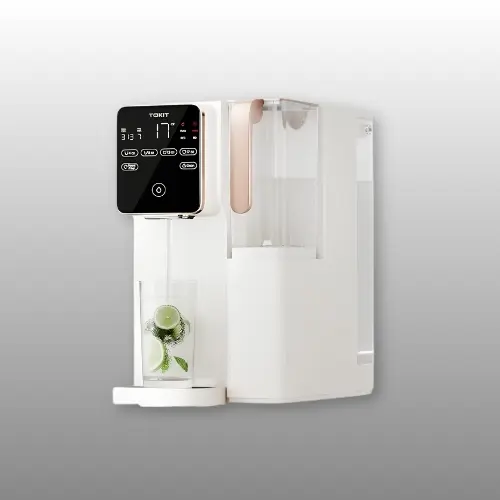
The TOKIT T1 doesn’t try to do everything — instead, it keeps things straightforward with a certified RO process, an alkaline remineralization filter for better taste, and a filter that lasts 24 to 36 months before it needs swapping. Stack that against pricier alternatives, and the math starts to favor the T1: certification plus a long filter life is exactly what keeps the cost-per-year down. Simply put, fewer filter changes mean less to think about.
Key Features
- SGS tests it; it carries certification to NSF/ANSI 58 & 42 and FCC standards
- Removes up to 99.99% of PFAS, fluoride, lead, chromium, iron, nitrate, chloride, and larger particles
- Includes an alkaline mineralized filter for improved taste
- Offers adjustable temperature, a child lock, and an LED display
- Runs on a filter lifespan of 24–36 months, reducing replacement frequency
Specifications
| Spec | Detail |
| Brand | TOKIT |
| Installation Type | Countertop |
| Material | Plastic, Activated Carbon |
| Product Dimensions | 16″L x 9″W x 16″H |
| Purification Method | Reverse Osmosis |
| Power Source | AC |
Pros: The 24–36 month filter life outlasts most countertop competitors, lowering long-term replacement costs; a child lock and adjustable temperature add household-friendly convenience; the SGS-tested contaminant removal list is extensive for the price point. Cons: TOKIT doesn’t publish a drain ratio or flow rate, making direct efficiency comparisons harder; the included pitchers run on the smaller side (1.4 liters), so you’ll refill more often than with a dual-pitcher setup.
Why This One Ranks Where It Does
Nothing else here matches its filter-life-to-certification ratio — a filter that lasts up to three years while still carrying independent SGS testing and NSF/ANSI certification isn’t easy to find. That’s the value case in a nutshell, and it’s why the T1 takes this spot among the five.
TOKIT T1 FAQ
How long do TOKIT T1 filters last? Between 24 and 36 months, longer than most countertop RO filters.
Is the TOKIT T1 independently certified? Yes — SGS tests it, and it carries certification to NSF/ANSI 58 & 42 and FCC standards.
Does the TOKIT T1 improve water taste? Yes, TOKIT designed the alkaline mineralized filter specifically to improve taste alongside contaminant reduction.
PHILIPS RO with Aquaporin Inside – Best Compact Water Filtration System
What Makes It Worth Considering
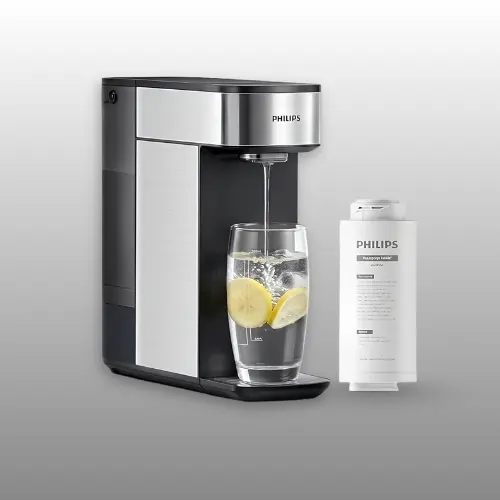
Not every kitchen has room for a bulky RO unit, and that’s really the problem PHILIPS set out to solve. The RO system fits into a slim 5″ x 13″ x 14″ footprint while still running a full 5-stage process, helped along by Aquaporin Inside technology — a filtration approach modeled on natural water-filtering proteins that’s rated to filter out impurities as small as 0.0001 microns.
Key Features
- Filtration: 5-stage RO with Aquaporin Inside technology
- Carries NSF/ANSI/CAN 372 & 58 certification; SGS additionally certifies the filter core
- Reduces chlorine, lead, calcium, and overall TDS
- Delivers roughly 9 oz of filtered water per minute
- Fits small kitchens, dorms, and offices with its slim, plug-and-play design
Specifications
| Spec | Detail |
| Brand | PHILIPS |
| Installation Type | Countertop |
| Material | Acrylonitrile Butadiene Styrene |
| Product Dimensions | 12.83″L x 4.44″W x 13.86″H |
| Power Source | Corded Electric |
| Included Components | Water pitcher, filter |
Pros: This model has the smallest footprint in the comparison, so it suits tight counter space well; Aquaporin Inside technology takes a genuinely different filtration approach from standard RO membranes; dual NSF/ANSI/CAN 372 & 58 certification plus an SGS-tested filter core back it up. Cons: A flow rate of about 9 oz per minute trails several competitors here; the included 16.9 oz bottle is small, so larger households will be refilling more often; the 2-year warranty covers the machine only, not the filter.
Why This One Ranks Where It Does
Its footprint beats everything else in this lineup by a wide margin, and Aquaporin Inside isn’t a technology any of the other four systems use. For anyone working with a genuinely small kitchen, that combination of size and a distinct filtration approach is what tips the decision in its favor.
PHILIPS RO FAQ
How compact is the PHILIPS water filtration system? About 12.83″ x 4.44″ x 13.86″ — the smallest footprint among the models compared here.
What is Aquaporin Inside technology? It’s a filtration approach built around Aquaporin proteins that mimic natural water filtration, used here to reduce impurities down to 0.0001 microns.
Does the PHILIPS RO system need professional installation? No — like the other countertop options in this comparison, it’s plug-and-play with no complex setup.
Final Verdict: Which Is the Best Water Filtration System 2026 Has to Offer?
- Best Overall — AquaTru Glass Carafe: The broadest contaminant removal in this comparison, backed by IAPMO testing and a glass carafe instead of plastic storage.
- Best Water-Saving Pick — Waken Electric C11S: A 4:1 pure-to-drain ratio and NSF/ANSI 58 & 61 certification make it the most efficient system here.
- Best for Families — Ecoviva Mate 3 UV: Dual auto-fill pitchers and a 5-year warranty solve the daily refill problem other countertop units don’t address.
- Best Value — TOKIT T1: A 24–36 month filter life paired with SGS/NSF certification keeps long-term costs down.
- Best Compact Pick — PHILIPS RO: The smallest footprint here, with Aquaporin Inside technology built for tight spaces.
Buying Guide: How to Choose the Best Water Filtration System for Your Home
Countertop vs. Under-the-Sink vs. Whole Home
A countertop water filtration system, like the five compared here, skips the plumbing entirely and moves with you, which is exactly why it works for renters, RVs, and apartments. By contrast, an under the sink water filtration system trades that portability for a hidden install and typically a higher flow rate. And if your concern goes beyond drinking water — showers, laundry, every tap in the house — that’s really the territory of whole home water filtration systems, or well water filtration systems if you’re on a private well. Both of those options require professional installation and a much bigger upfront investment than anything on this list.
Filtration Stages and Technology
Stage count alone doesn’t tell you much — what actually matters is what each stage targets. Both the Ecoviva Mate 3 UV and Waken Electric C11S add UV light on top of standard RO filtration, while the PHILIPS RO takes a different route entirely with its Aquaporin Inside stage, modeled on natural filtering proteins. The AquaTru Glass Carafe, by contrast, built its 4-stage process around breadth of contaminant coverage rather than piling on extra stages.
Certifications to Look For
NSF/ANSI certification is the baseline worth checking for any water filtration system. The TOKIT T1 carries NSF/ANSI 58 & 42, the Waken Electric C11S carries NSF/ANSI 58 & 61, and the PHILIPS RO carries NSF/ANSI/CAN 372 & 58, while IAPMO independently tests the AquaTru Glass Carafe. Meanwhile, third-party testing from labs like SGS, which shows up on both the TOKIT T1 and PHILIPS RO, adds another layer of verification beyond whatever the manufacturer claims on the box. If you’re also weighing something like the waterdrop countertop filter lineup, look for that same kind of NSF/ANSI documentation before comparing specs side by side.
Drain Ratio and Water Waste
Older RO systems can waste several gallons of water for every gallon they actually produce. In comparison, the Waken Electric C11S’s 4:1 ratio and the Ecoviva Mate 3 UV’s 3:1 ratio both mark a real improvement, which matters if your unit is going to run every day.
Budget and Ongoing Costs
The sticker price is only part of what a countertop water filtration system actually costs you — filter-replacement frequency matters just as much over time. The TOKIT T1’s 24–36 month filter life keeps ongoing costs down, while the AquaTru Glass Carafe splits replacement across three separate filter stages with different lifespans. It’s worth weighing that against other well-known names in the category too, like the waterdrop countertop filter line, when you’re comparing long-term filter costs.
Frequently Asked Questions
What is the best countertop water filtration system for removing PFAS? Both the AquaTru Glass Carafe and TOKIT T1 specifically test for PFAS reduction — AquaTru covers PFOA and PFOS as part of its 84-contaminant list, and TOKIT rates the T1 to reduce PFAS up to 99.99%.
Do I need a whole home water filtration system, or is a countertop unit enough? If you only need clean drinking and cooking water, any of the five countertop units here covers that without touching your plumbing. On the other hand, systems built for whole-house coverage — including well water filtration systems for private wells — make more sense if you want filtered water at every tap, not just one.
Is an under the sink water filtration system better than a countertop model? It really depends on your priorities. An under-the-sink setup stays out of sight and often runs a higher flow rate, but it requires installation and isn’t portable. A countertop model, on the other hand, gives up a little counter space in exchange for zero installation and the ability to take it with you.
What does TDS mean, and why do some systems monitor it? TDS (Total Dissolved Solids) measures the concentration of dissolved minerals and impurities in your water. Systems like the Waken Electric C11S and Ecoviva Mate 3 UV include built-in TDS monitors so you can see filtration performance in real time instead of guessing.
How often do countertop RO filters need to be replaced? It varies by model. The TOKIT T1’s filter lasts 24–36 months, the PHILIPS RO’s filter lasts about 12 months, and the AquaTru Glass Carafe splits replacement across three stages ranging from 6 months to a year.
Can I use HSA or FSA funds toward a water filtration system purchase? Some water filtration systems may qualify for HSA/FSA purchases depending on your provider’s rules, so it’s worth confirming eligibility before you buy.
Conclusion
For most households, the AquaTru Glass Carafe stands out as the strongest all-around water filtration system, thanks to its broad contaminant removal and independent testing. If cutting down on wasted water matters most to you, the Waken Electric C11S’s 4:1 drain ratio is hard to beat, and the Ecoviva Mate 3 UV’s dual pitchers make it the easiest fit for a busier, multi-person household. Meanwhile, budget-focused buyers will get the most mileage out of the TOKIT T1’s long filter life, and the PHILIPS RO remains the go-to pick if counter space is tight.
Ultimately, match your choice to your household size, your specific contaminant concerns, and how much counter space you actually have — not just the spec sheet — and you’ll end up with cleaner water and a lot fewer surprises down the line. For a closer look at options built for whole-house coverage, see our [Best Water Purifier Countertop 2026].