
Most “best security camera” roundups just list resolution numbers and a WiFi logo and call it a day — not much help if you’re actually trying to pick a solar powered security camera or a wireless outdoor security camera for your own house. In reality, the details that actually decide whether a camera works out for your house rarely get mentioned: whether it needs a subscription to be useful, how many cameras the kit really covers once you account for blind spots, and whether your own hard drive or someone else’s cloud server holds the footage. Get those details wrong, and you either end up paying $10 a month you didn’t plan for, or you’re left with a gap right where the delivery guy walks up.
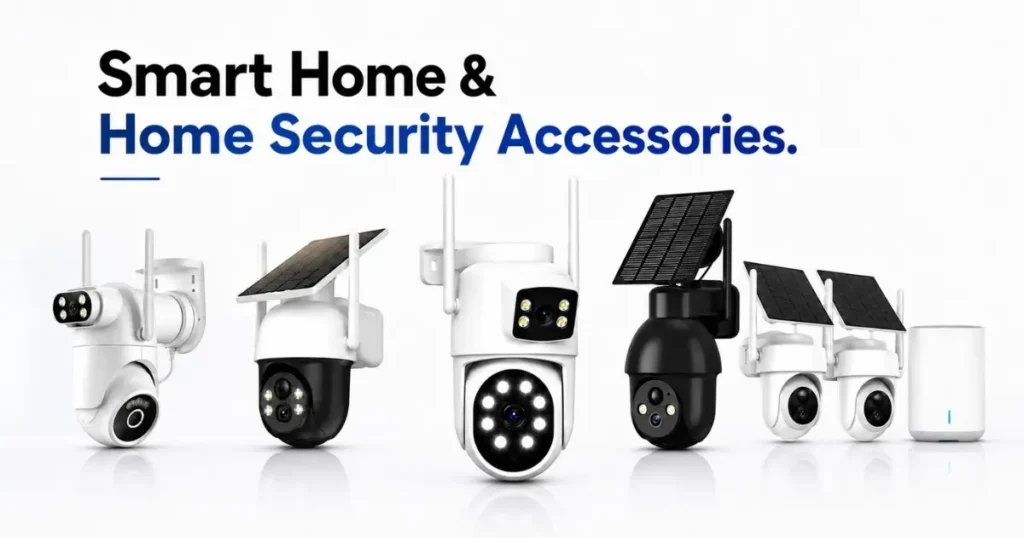
Here are five systems that keep coming up in searches for solar powered security cameras and wireless outdoor security cameras: the ANRAN Solar Security Camera (2-pack, 360° PTZ), the aosu D1 Max 4-Cam Kit, the YOYIRYB 4K Solar Security Camera System, the Kittyhok Dual-Lens NVR Kit, and the Camcamp Dual-Lens 4-Cam Kit. A couple run entirely on sunlight, two are plug-in NVR setups built around local hard drives, and one is a smaller, cheaper starting point if you just want a camera or two on the front of the house. Overall, here’s how they stack up on power, storage, tracking, and what actually comes in the box.
Quick Comparison Table
| Model | Power Source | Cameras Included | Resolution | Storage | Best For |
| aosu D1 Max 4-Cam Kit | Solar + Battery | 4 | 4K (8MP) | 32GB local, expandable to 1TB | Best overall solar security camera system |
| YOYIRYB 4K Security Camera System | Solar + Battery | 4 | 4K (8MP) | 64GB base station, expandable to 128GB | Best for extreme cold weather (-14°F) |
| Kittyhok Dual-Lens NVR Kit | Corded (NVR) | 4 (dual-lens, 8 views) | 2K (4MP) | 500GB HDD, expandable to 6TB | Best NVR system for continuous recording |
| Camcamp Dual-Lens 4-Cam Kit | Corded (Plug-in) | 4 (dual-lens, 8 views) | 4K | 500GB HDD | Best value multi-camera, no monthly fee |
| ANRAN Solar Security Camera | Solar + Battery | 2 | 2K (3MP) | Micro SD (up to 128GB) + optional cloud | Best single/budget solar camera pick |
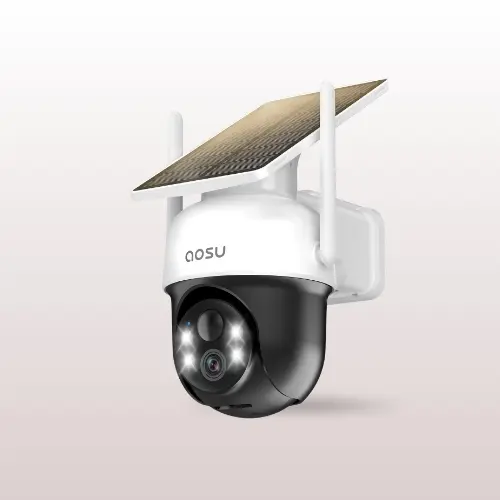
aosu D1 Max 4-Cam Kit — Best Overall Solar Powered Security Camera System
What Makes It Worth Considering
Out of everything on this list, this is the kit that gets closest to covering a whole house without add-ons. Four cameras, true 4K, and on-device AI that can tell a person apart from a passing car (or a raccoon setting off the sensor at 2am) — that combination is hard to match here. On top of that, the base station, aosuBase, ties all four feeds into one timeline instead of leaving you with four separate clips to piece together. So if most of your comparison shopping has been about resolution numbers, this is the one that also gets the “thinking” part right.
Key Features
- Captures 4K Ultra HD (8MP) footage with 6x digital zoom, sharp enough to read a license plate from about 33 feet away
- On-device AI distinguishes people from vehicles, cutting down on false alerts
- Smart Vehicle Guard watches parked cars specifically and flags nearby movement
- 360° pan-tilt-zoom coverage with automatic tracking of moving subjects
- Cross-camera tracking via aosuBase strings footage from all four units into one timeline
- Local storage only — 32GB included, expandable up to 1TB, no monthly subscription required
- Detached solar panel can be positioned separately from the camera for better sun exposure
Specifications
| Spec | Detail |
| Brand | aosu |
| Model Name | C9S13 |
| Power Source | Solar Powered, Battery Powered |
| Number of Cameras | 4 |
| Video Resolution | 4K (8MP), 6x digital zoom |
| Night Vision | Full color, up to 33 feet |
| Viewing Angle | 360 degrees |
| Battery Capacity | 5200 mAh |
| Storage | 32GB installed, expandable to 1TB |
| Connectivity | Ethernet (base station) / Wireless (cameras) |
| Waterproof Rating | IP65 |
| Form Factor | Dome |
| Unit Count | 4 |
The AI detection actually cuts down on notification spam compared to plain motion sensors, and reviewing an event across four synced feeds beats scrubbing through separate clips one by one. Better still, you don’t need a subscription to get full use out of it, and the detached solar panel gives more flexibility on awkward mounting spots. That said, the base station needs an Ethernet connection to your router, so it’s not entirely wire-free, and four cameras — while generous — might still need supplementing on a larger lot.
Why This One Ranks Where It Does
In short, nothing else here matches true 4K clarity plus on-device AI plus the cross-camera storytelling all at once. If you’re after a solar power camera setup that acts like one system rather than four cameras that happen to share a WiFi password, this is the one to beat.
aosu D1 Max FAQ
Does the aosu D1 Max need a subscription? No — the included storage (32GB, expandable to 1TB) stores recordings locally, with no monthly fee required. How far can the night vision see? Full color night vision reaches up to about 33 feet, and an infrared mode is also available for more discreet monitoring. Can I expand the system beyond 4 cameras? The 4-cam kit covers a standard single-family home’s front, back, and side yards, and you can add more aosu cameras to the same base station as needed.
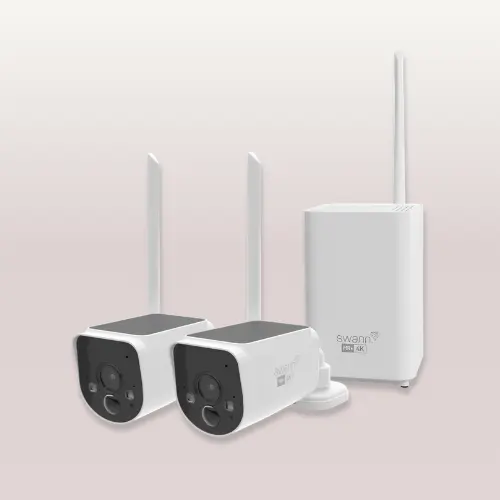
Swann MaxRanger4K Solar 4K Security Cameras Wireless Outdoor, 2-Camera Kit
What Makes It Worth Considering
If range is the one thing your property can’t compromise on, this is where the Swann MaxRanger4K pulls ahead of most wireless outdoor security camera setups. Instead of relying on standard home Wi-Fi, it runs on 900MHz Wi-Fi HaLow — a connectivity choice that pushes coverage out to roughly 2,000 feet in open air. That’s the kind of number that matters if you’re trying to watch a barn, a back gate, or a driveway that sits well outside your router’s normal reach. Pair that with 4K clarity and color night vision, and this kit reads less like a doorbell-camera upgrade and more like a solar security camera system built for acreage rather than a townhouse.
Key Features
- Delivers 4K Ultra HD footage with Night2Day color night vision, sensor spotlights, and long-range infrared for consistent day-and-night detail
- Wi-Fi HaLow connectivity extends usable range up to 2,000ft open-air, around 20x what typical wireless security cameras outdoor systems manage
- Fully solar powered with rechargeable batteries built in, so placement isn’t limited by outlet access or cable runs
- True Detect+ AI separates heat signatures from motion, flagging people and vehicles specifically instead of every leaf or shadow
- Active deterrence built in — spotlights, sirens, and 2-way audio trigger automatically once a threat is confirmed
- Base station holds a 64GB card (expandable to 512GB), storing up to 12 months of rolling footage without a subscription
Specifications
| Spec | Detail |
| Brand | Swann |
| Model Name | SWNVK-MAXV2SD2 |
| Power Source | Solar Powered |
| Number of Cameras | 2 |
| Video Resolution | 4K, Color Night Vision |
| Connectivity | Wi-Fi HaLow (Wireless) |
| Range | Up to 2,000 ft open-air / 650 ft typical |
| Storage | 64GB installed, expandable to 512GB |
| Special Features | 2-Way Audio, App Control |
| Form Factor | Wireless Camera |
| Indoor/Outdoor Use | Indoor, Outdoor |
| Unit Count | 2 Cameras + Base Station |
Where this kit earns its keep is distance — most outdoor wireless security cameras start losing signal well before they hit even half of what Wi-Fi HaLow covers here, so it’s a natural fit for farms, rural lots, or any property where the perimeter stretches past what a router can reach. The local storage with no monthly fee is a real plus too, and 12 months of rolling footage on a single card is generous for a solar power camera setup. On the flip side, this is a 2-camera kit, so larger properties may need to add units, and Wi-Fi HaLow’s long range comes with lower bandwidth than standard Wi-Fi — fine for surveillance footage, but worth knowing going in.
Why This One Ranks Where It Does
For anyone whose search really started with “how far can a solar panel security camera actually reach,” this is the answer. Nothing else on this list matches the sheer coverage radius Wi-Fi HaLow provides, and combining that with 4K, active deterrence, and subscription-free storage makes it the clear pick for rural or spread-out properties rather than tight urban lots.
Swann MaxRanger4K FAQ
Does the Swann MaxRanger4K need a subscription?
No — the included 64GB card (expandable to 512GB) stores up to 12 months of footage locally, with optional cloud backup available through the Swann Security App if you want it.
How far can these cameras actually reach?
Up to 2,000ft in open-air conditions, or around 650ft in typical real-world settings with obstacles — well beyond what most standard outdoor camera security wireless systems offer.
Is this kit expandable?
The 2-camera kit ships with a base station built to support additional Swann cameras, so larger properties can scale up coverage as needed.
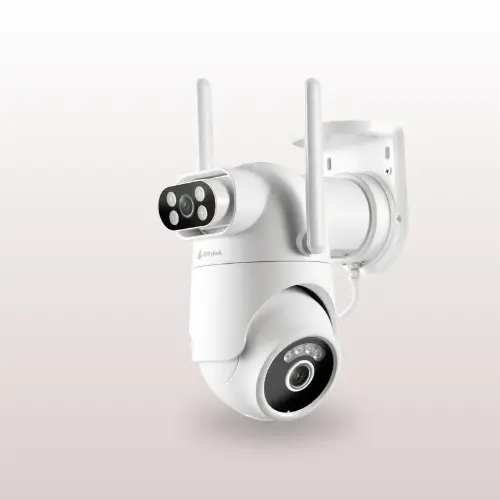
Kittyhok Dual-Lens NVR Kit — Best Wireless Security Camera System for Continuous Recording
What Makes It Worth Considering
Each camera in this kit is really two cameras in one housing: a fixed wide-angle lens plus a PTZ lens that pans 355° and tilts 90°. As a result, four physical units end up giving you 8 usable views. Add a 10-channel WiFi 6 NVR with a 500GB drive that can grow to 6TB, and you’ve got a setup meant for people who want a real 24/7 recording history sitting on their shelf, not just a folder of motion-triggered clips.
Key Features
- Dual-lens design per camera: one fixed wide-angle lens plus one PTZ lens covering a second area at the same time
- WiFi 6 NVR with dual-band (2.4GHz/5GHz) support for more stable streaming
- 10-channel NVR with 500GB HDD included, expandable up to 6TB, giving up to 25 days of continuous recording
- Automatic motion tracking with spotlight and siren activation on detected activity
- 8 IR/white LEDs deliver color night vision in low light
- Two-way audio and IP65 weatherproofing for outdoor reliability
Specifications
| Spec | Detail |
| Brand | Kittyhok |
| Model Number | KXDK4 |
| Power Source | Corded Electric |
| Number of Cameras | 4 (dual-lens, 8 views total) |
| Video Resolution | 2K (4MP) |
| Night Vision | Color, up to 33 feet |
| Viewing Angle | 360 degrees |
| NVR Channels | 10 |
| Storage | 500GB HDD included, expandable to 6TB |
| Connectivity | Wireless (camera-to-NVR), Ethernet/HDMI/USB (NVR) |
| Frame Rate | 15 fps |
| Unit Count | 5 (4 cameras + 1 NVR) |
The dual-lens setup basically doubles your coverage per camera without doubling the amount of mounting work, and 500GB of onboard storage will hold weeks of footage before you need to delete anything. WiFi 6 keeps things stable on busier home networks, and since storage stays local and encrypted, nothing here depends on a cloud company staying in business five years from now. The tradeoffs, though: cameras need to be plugged into power, so cable routing is something to plan for at install time, and 2K resolution is a step down from the 4K options elsewhere on this list.
Why This One Ranks Where It Does
If storage depth and dual-angle coverage matter more to you than chasing the highest resolution number, 8 effective views paired with a 500GB-to-6TB NVR is tough to beat. That’s the whole case for its spot on this list.
Kittyhok Dual-Lens NVR Kit FAQ
Does this system need an internet connection to record? No — the NVR handles recording locally and stores it on the included hard drive, independent of internet access. How many views does the 4-camera kit provide? Each camera has two lenses, so the 4-camera kit provides 8 total views. Can the storage be expanded? Yes, you can swap the included 500GB HDD for drives up to 6TB.
Camcamp Dual-Lens 4-Cam Kit — Best Value Multi-Camera Security System, No Monthly Fee
What Makes It Worth Considering
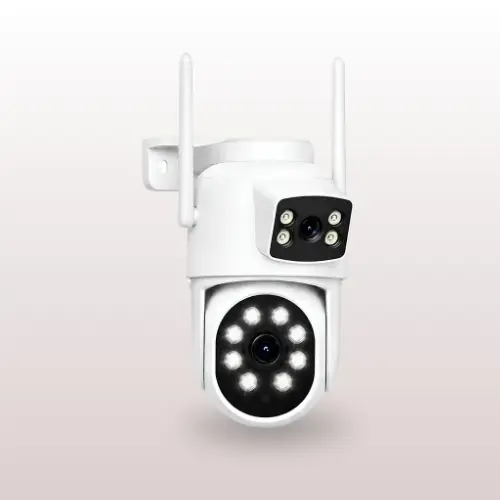
Camcamp borrows the same dual-lens trick as Kittyhok — one fixed wide lens, one PTZ lens per camera, four cameras giving you eight views — but pairs it with H.265 compression, which reportedly cuts storage use nearly in half versus older H.264 setups. Add the included 500GB drive and a 10-channel NVR that scales up to 4K per channel, and it’s a decent answer if you’re specifically hunting for outdoor camera security wireless setups that don’t come with a subscription attached.
Key Features
- Dual-lens system per camera: fixed wide-angle lens plus remote-controlled PTZ lens for simultaneous broad and close-up views
- Intelligent night vision automatically switches from black-and-white to full color once motion is detected, while using less power than standard infrared
- Auto human tracking with sound and light alarms plus instant app push notifications
- 500GB HDD included with no monthly fee, using H.265 compression to extend storage life
- 10-channel NVR supports expansion up to 10 cameras at resolutions up to 4K
- IP66 weatherproof rating for reliable outdoor use
- 1-year warranty with 30-day no-reason return
Specifications
| Spec | Detail |
| Brand | Camcamp |
| Power Source | Corded Electric (plug-in) |
| Number of Cameras | 4 (dual-lens, 8 views total) |
| Video Resolution | 4K |
| Night Vision | Color, up to 65 feet |
| Viewing Angle | 360 degrees |
| Zoom | 8x digital |
| NVR Channels | 10 (expandable) |
| Storage | 500GB HDD included |
| Video Encoding | H.265 |
| Waterproof Rating | IP66 |
| Frame Rate | 30 fps |
| Unit Count | 1 |
This one has the longest night vision range on the list, reaching up to 65 feet, and H.265 compression stretches that included 500GB noticeably further than older-format systems would. Dual lenses mean the same 8-views-from-4-cameras math as Kittyhok, plus there’s no monthly fee and a full year of warranty backing it up. The downside is it needs each camera plugged into an outlet — no wire-free solar option here like the aosu or YOYIRYB — and since Camcamp markets it for indoor/outdoor dual use, some accessories feel shared rather than built specifically for the outdoors.
Why This One Ranks Where It Does
Longer night vision range, storage-efficient compression, a 10-channel NVR with no subscription attached — if you don’t mind running power cables in exchange for four dual-lens cameras and real local storage, this is the best value here.
Camcamp Dual-Lens 4-Cam Kit FAQ
Does the Camcamp system require a subscription? No, the included 500GB hard drive records footage with no monthly fee. How far does the night vision reach? Up to 65 feet, with automatic color night vision triggered by motion detection. Can this system be expanded past 4 cameras? Yes, the NVR supports up to 10 channels, so you can add more cameras later.
ANRAN Solar Security Camera (2-Pack) — Best Budget Solar Powered Security Camera
What Makes It Worth Considering
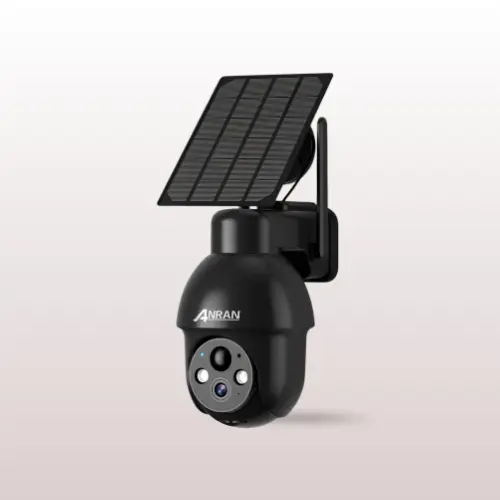
Not everyone needs a four-camera setup with an NVR bolted on. The ANRAN 2-pack is a smaller, cheaper way into solar panel security cameras: 360° PTZ coverage, PIR detection tuned for humans specifically, and a 3W solar panel meant to keep the battery charged year-round without plugging in anything. It’s a reasonable starting point if all you need is a front door and one backyard angle covered.
Key Features
- 360° panoramic PTZ coverage with 4x digital zoom, clear enough to check faces at around 50 feet
- 3W adjustable solar panel designed to keep the battery charged year-round with no wiring
- Advanced PIR sensor with AI human detection triggers siren, spotlight, or app notification alerts
- Three night vision modes: Smart, Color, and Infrared, switching automatically based on detected activity
- Built-in two-way audio for real-time conversation through the mobile app
- Supports both local Micro SD storage (up to 128GB) and optional cloud storage
- IP65 rated for dust and water resistance, rated from -20°F to 122°F
- Alexa compatible for voice-based monitoring
Specifications
| Spec | Detail |
| Brand | ANRAN |
| Model Name | Q03-3MP-2Pack-Black |
| Power Source | Solar Powered, Battery Powered |
| Number of Cameras | 2 |
| Video Resolution | 2K (3MP), 4x digital zoom |
| Night Vision | Color, up to 50 feet |
| Viewing Angle | 360 degrees |
| Battery Capacity | 5000 mAh |
| Storage | Micro SD up to 128GB, optional cloud |
| Connectivity | WiFi (2.4GHz only) |
| Waterproof Rating | IP65 |
| Operating Temperature | -4°F to 122°F |
| Form Factor | Bullet |
| Unit Count | 2 |
It costs noticeably less than the 4-camera systems on this list, which makes it an easy first step into solar cameras generally, and the 360° coverage is real per-camera rotation rather than a fixed angle pretending to be wide. Three night vision modes handle most lighting situations on their own, and Alexa support is a nice-to-have for voice checks. However, the catch is that it only runs on 2.4GHz WiFi, not 5GHz, which can be an issue on newer mesh routers, and with just 2 cameras at 2K resolution, it won’t fully replace a bigger NVR-based setup on a larger property.
Why This One Ranks Where It Does
It’s the cheapest, simplest entry point on this list. If you’re not sure a solar powered security camera even fits your routine yet, this is a sensible place to find out before spending more on a bigger kit.
ANRAN Solar Security Camera FAQ
Does the ANRAN camera need a subscription? No, it supports local Micro SD storage, though optional cloud storage is also available. Does it work with 5GHz WiFi? No, it only supports 2.4GHz WiFi networks. How cold or hot can this camera operate in? ANRAN rates it to operate between -4°F and 122°F.
Final Verdict: Which Is the Best Smart Home Security Device?
If you want the most complete solar powered security camera system here, that’s the aosu D1 Max — it combines 4K, AI detection, and cross-camera tracking better than anything else on this list.
For homes dealing with actual winter weather, the YOYIRYB 4K system is the one built and rated for that specifically, down to -14°F.
Prioritizing storage and dual-angle coverage over squeezing out the last bit of resolution? Go with the Kittyhok Dual-Lens NVR Kit — 8 views and up to 6TB of local recording.
Want longer night vision range and efficient storage without paying a subscription? The Camcamp Dual-Lens Kit is the better value of the two plug-in systems here.
And if you just want to dip a toe into solar security cameras without spending much, the ANRAN 2-Pack is about as simple as it gets.
Buying Guide: How to Choose the Best Solar Powered Security Camera
Solar vs. Plug-In Power
The aosu, YOYIRYB, and ANRAN kits skip wiring entirely, which is the whole appeal if you’re mounting a camera on a detached garage, a fence line, or anywhere else nowhere near an outlet. By contrast, Kittyhok and Camcamp go the other way — plug-in power in exchange for uninterrupted uptime and, usually, more storage capacity than a battery-based unit can support.
Local Storage vs. Cloud
Subscription-free is basically the norm now. Every system reviewed here handles local storage in some form, whether that’s a 32GB base station on the aosu or a 6TB-capable NVR on the Kittyhok. So if a monthly fee is a dealbreaker for you, lean toward whichever system comes with local storage built in from day one rather than offering it as an optional add-on.
Resolution and Night Vision Range
4K units (aosu, YOYIRYB, Camcamp) hold up noticeably better when you zoom in than the 2K systems (Kittyhok, ANRAN) — that matters if reading a plate number or clearly making out a face is the point. Meanwhile, night vision range swings a fair amount too, anywhere from 30 feet to 65 feet across this lineup, so it’s worth checking that number against how far your camera will genuinely need to see.
One Camera vs. a Full Kit
Two cameras, like the ANRAN pair, cover a front door and maybe one more angle — fine for smaller homes or apartments. In contrast, the four-camera kits, especially the dual-lens Kittyhok and Camcamp systems that effectively double up to 8 views, make more sense once you’re trying to cover a driveway, backyard, and side yards all at once.
AI Detection vs. Basic Motion Sensing
Plain PIR sensing, like on the ANRAN, flags anything that moves — cars, cats, tree branches, all of it. By comparison, AI-based detection on the aosu and YOYIRYB filters that down to people and vehicles specifically, which makes a real difference if a previous camera has been burying you in useless notifications.
Frequently Asked Questions
What is the best solar powered security camera in 2026? It depends on what you need covered. The aosu D1 Max is the strongest pick if you want a full system, and the ANRAN 2-pack works fine as a cheaper starting point for a smaller setup.
Do solar security cameras still work if it’s cloudy for a few days? Generally, yes. The YOYIRYB system, for example, is built to run off battery reserves through cloudy stretches and only needs a couple hours of actual sun to stay charged.
Do wireless outdoor security cameras require a subscription? Not for any of the five reviewed here. Micro SD cards, base stations, and NVR hard drives all handle local storage without a mandatory monthly plan.
What’s the actual difference between a single-lens and dual-lens camera? A dual-lens unit — the Kittyhok and Camcamp cameras both work this way — pairs a fixed wide-angle lens with a separate PTZ lens, so one camera housing gives you two distinct views instead of one.
How many cameras does a typical house need? Two cameras usually cover a front door plus one more angle. Four-camera kits are the more common recommendation once you’re trying to cover the front, back, and side yards of a standard house.
Can any of these hold up in extreme cold or heat? It varies. YOYIRYB is rated down to -14°F specifically, while something like the ANRAN sits in a milder -4°F to 122°F range.
Conclusion
Ultimately, the right setup here comes down to how much ground you need to cover and whether solar or plug-in power fits your situation better. Go with the aosu D1 Max if you want the most complete all-around solar system; the YOYIRYB if cold-weather reliability matters where you live; the Kittyhok kit if storage and dual-angle coverage are the priority; the Camcamp kit for the best value among the plug-in options; and the ANRAN 2-pack if you just want a low-cost way to get started.
So match the system to your property, your climate, and how much storage you want to manage — not just whichever box has the biggest resolution number printed on it — and it should hold up fine through the seasons ahead. For more comparisons like this, check out our [related buying guides] on abestfive.com.